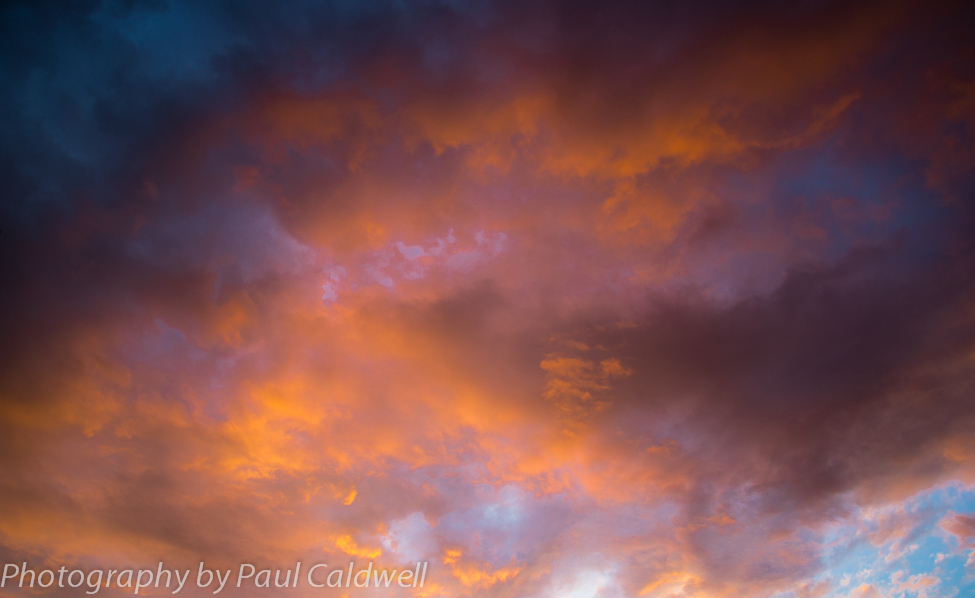
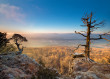
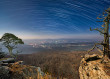
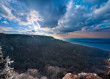

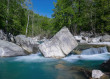

Ellis Widner, Style Editor of the Arkansas Democrat Gazette, had the following kind words to say about my “Arkansas and the Range of Light” exhibition at Cantrell Gallery:

Paul Caldwell’s show at Cantrell Gallery is ravishingly beautiful; the sometimes saturated color digital photographs of Arkansas landscapes can take on the aura of photorealistic paintings.

Satisfying shows by 2 Little Rock photographers


If you did not have a chance to catch the exhibit, it is available online; Arkansas and the Range of Light Gallery has more.

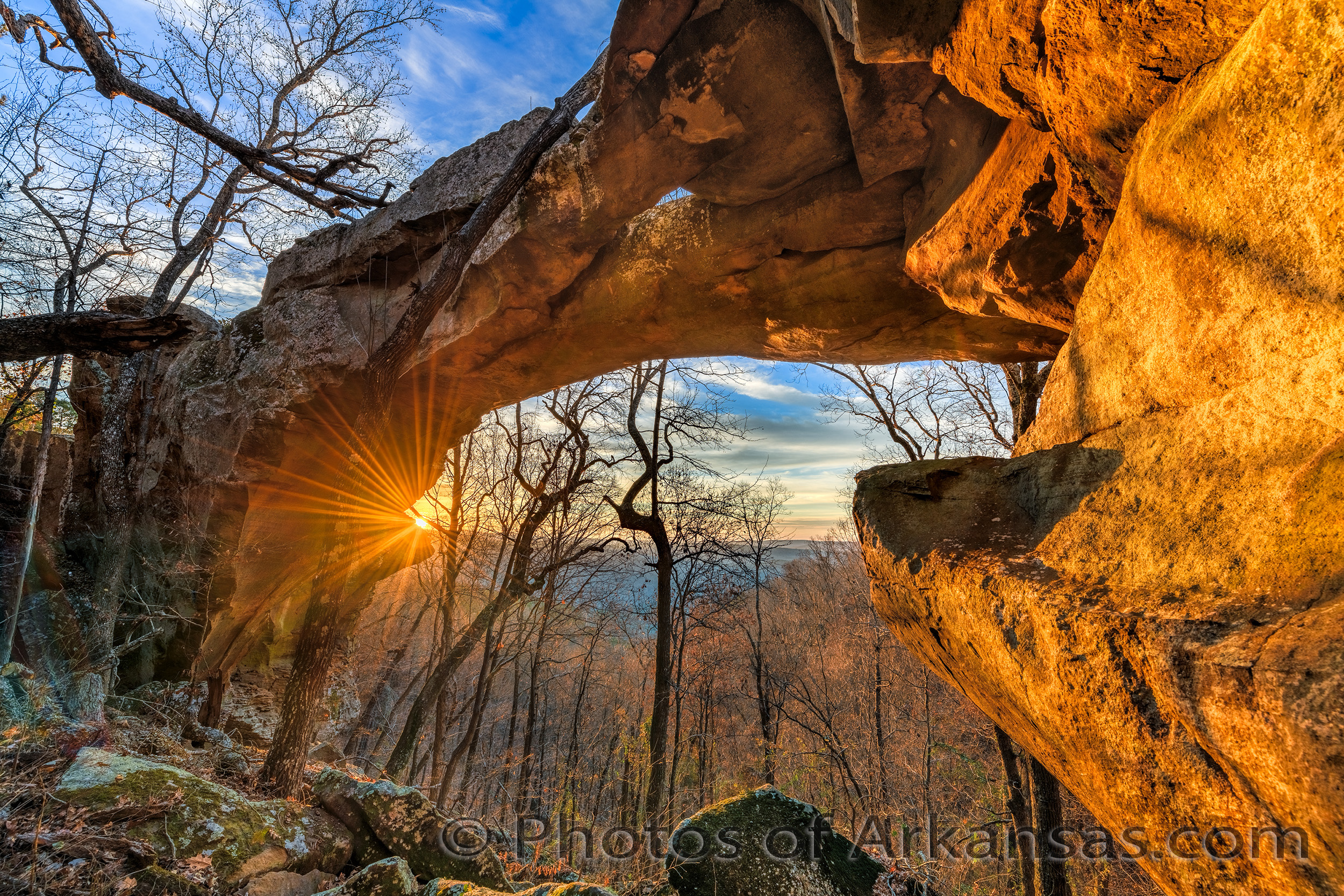
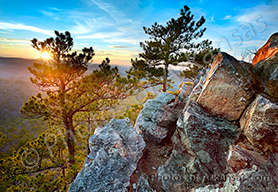
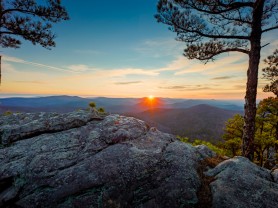
Sam's Throne in Newton County sunset

Sam's Throne sunset early Autumn--Click on image for a larger view

Taken in 2007, with a 1Ds MKII, 24-70 Lens at F11 24mm, ISO 100. You can find some really nice fall views up at Sam’s Throne right now. The colors up there have just about peaked and should be good for the next few days.  The best time to photograph Sam’s on a clear day, would be from early morning till when the sun has crossed over and is in front of the throne.  So anytime from dawn till around 2:00 pm.  Anytime after that and you will be shooting right at the sun.  I feel that a sunny day is much better for shooting fall foliage (something many others would disagree with), but on a sunny day, you will pull much more color and contrast from the leaves which will make the scene just POP.  This image was taken as a HDR and I used the period of when the sun just has set behind the ridge in the distance to get the best effect.  Sam’s has some great views and it is a wonderful spot to spend the day.


Fall Vista from Sam's Throne

Fall Vista from Sam't Throne--Click on image for a larger view

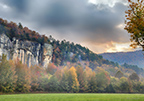
One of the best views in Arkansas, in my humble opinion, is the westward view from the summit of Sam’s Throne.  Here you can see all the way to the Buffalo River on a clear day.  In this view the large mountain in the distance on the right side of the image is Red Rock.  The valley down from Red Rock is the valley of  Vendor and St. Hwy 374 runs east and west through the valley.  Sam’s Throne is one of the major climbing spots in Arkansas and recently the area was improved for camping and a restroom was added.  This is a great day trip from Little Rock and in the past I have always had good fall color at Sam’s.  So far I have yet to find anything in the way of good color in the State, especially on the Buffalo River, Richland Creek or the Stack Rock area.  I have yet to make the drive to Sam’s Throne but plan to make it up there next week.


Since I started to print on Canvas over 5 years ago, I have been looking for a Glossy canvas that will give me the look and feel of a high gloss photographic print.  The ability to use the Photo black ink set  and get the best overall Dmax is very important to me. I have tried many different brands over the years  but always ended up coming back to using a Matte canvas and applying a glossy coating.    Here are some of the reasons for this.

 1.  The glossy canvas had too heavy a gesso top coating which left  the final print looking lifeless.

2.  The canvas had too stiff a hand and thus was hard to load into the printer and stretch later on.

3.  The coating was easily damaged during printing or stretching.

4.  The coating didn’t  hold up over time and flaked off or bubbled.

5.  The top coating was so strong that you really didn’t see very much weave in the canvas.

6.  Every glossy canvas I used needed to be top coated to protect the print.

All of these issues have given me fits over the years and I finally just settled on using Breathing Color’s Chromata White, and coating it with Timeless gloss.  However I always kept my eyes and ears open for a new player.

In March of 2011, I heard from my local Breathing Color rep, that they were working on a totally “new” glossy canvas. This canvas was called Crystalline.  Crystalline would be a new glossy canvas for aqueous ink based printers that would address each of my concerns.   Just being able to remove the top coating step alone was worth considering this new canvas since  top coating in my environment is by far the single most time consuming part of creating a canvas print.   I  eagerly ordered a few rolls and hoped that finally I could start using a glossy canvas again.  Unfortunately, this early release of Crystalline had a few problems and it was not useable.  In fact it has taken Breathing Color until now to get this canvas to the point where it can be sold.  Breathing Color has shown  Crystalline on their website,  www,breathingcolor.com most of 2011, but you were not able to order it.

Two weeks ago I received 2 new rolls of Crystalline.  This was an early release of the final product that soon will be going to market by Breathing Color.  After making a few prints and stretching them, I can safely say that this is one of the most impressive glossy canvas solutions I have ever printed with  and would have to say it’s a revolutionary product.

Crystalline print coming off of a Epson 9880

Epson 9880 and 44 inch Roll of Crystalline

As you can see in this photo,  the canvas which is OBA free, has a very bright white and  the resulting prints have a deep rich tone and the colors are fabulous.   As soon as I got the canvas I profiled it with i1 profiler.  I printed the test patterns using several different media settings, Watercolor radient White, and Premium Glossy Photo Papaer 250W to name a few.  However each time I printed the test patterns, I kept seeing ink blotches in the light colors.  Not sure what was causing this, I called Breathing color and they informed me that Crystalline’s coating did not require as much ink as Matte canvas and other glossy canvas.   I worked with Paul Morales, one of the tech’s at Breathing Color and found out that for Crystalline on my 9880, I needed to use a different media setting and also reduce the ink density.  After some experimentation, I discovered that the best settings for my 9880 were to use a media setting of Premium semimatte 250W and a ink density  setting of -15.

With these settings, I was able to get clean test patterns printed and scan them in with no more problems.  It’s safe to say that if you work with Crystalline, you will have to spend some time fine tuning the canvas to your printer, however Breathing Color is working on a table of custom settings that should be published in the future.  One note, the  customer support from Breathing Color has been excellent throughout this entire process.


The rolls I purchased were 44″ rolls but the canvas will be sold in 17″, 24″, and 36″ rolls also.  One feature that Crystalline shares with some of the other canvas lines from Breathing Color is the new core padding.  This is designed to help protect the last 10 feet of the roll from the pressure stripes that appear.  I have not taken a roll down that far yet, but have added a picture of the core to show how the padding solution works.

New padded core from Breathing Color
New padded core from Breathing Color for Crystalline


Read the remainder of this entry »

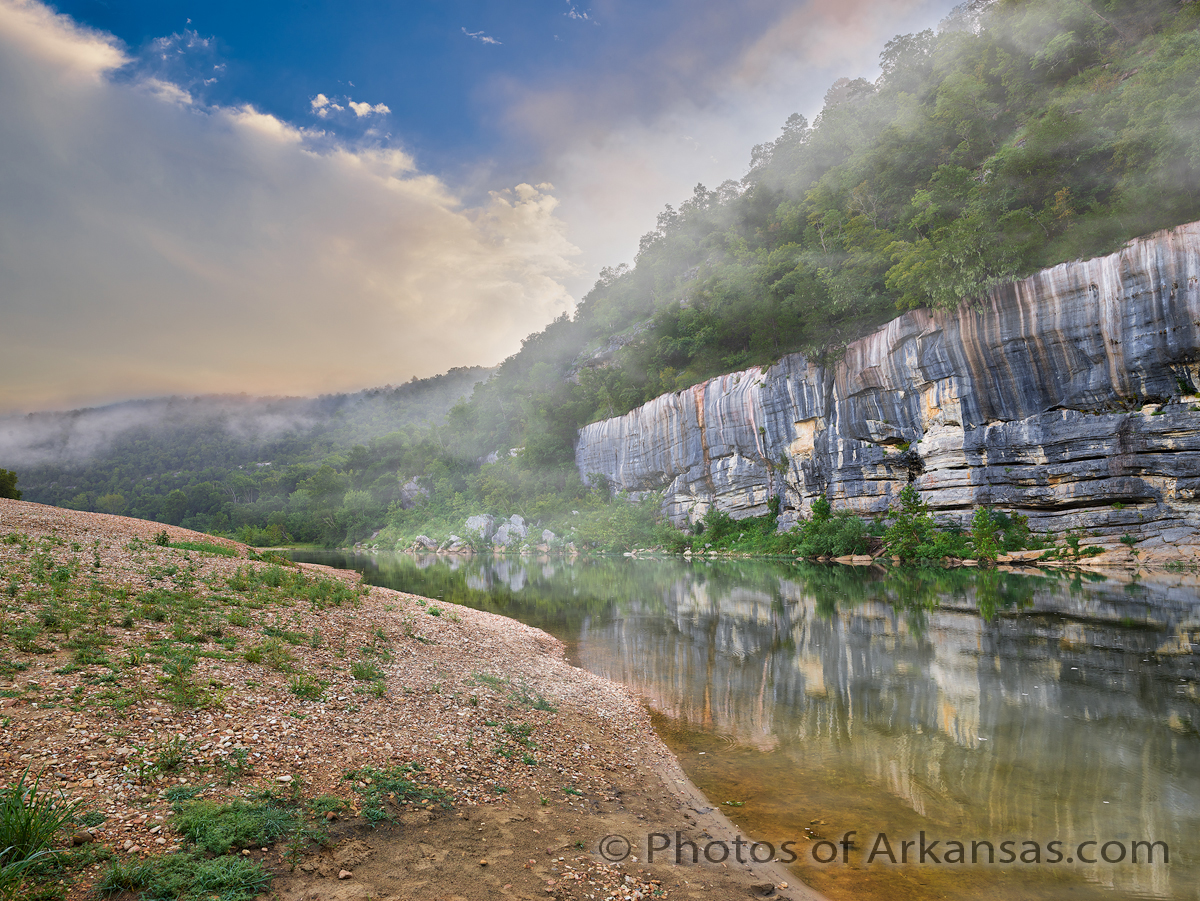
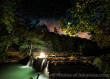
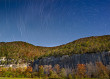
Early Morning along the Buffalo River

Early morning along the Buffalo River--Click on image for a larger view

Taken with a Canon 1ds MKII, on Tripod, shutter speed 1/20 of a second with a 24-70 F 2.8 lens at 24mm, ISO 100. The Buffalo River is a great place so spend sometime with your camera, but in the fall and one of the best times would be the fall.  You can count on some good color along the banks of the river and depending on the season and rainfall possibly good color all around.  There is good access to the Buffalo River along it’s entire length, but I like to hike it along the upper end near Ponca.  Here you will find some of the tallest bluffs of the entire river including Big Bluff which by most accounts is the tallest on the river at over 500 feet.  Trails abound both official and game trails and it will be well worth your trip!

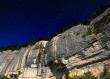
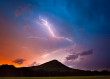
Autumn Night sky over Roark Bluff

Autumn Night sky over Roark Bluff--Click on photograph for a larger view

Taken with a Canon 5D MKII, 27 minute exposure at ISO 100, 14mm lens at F5.0.  The night sky can really become a beautiful sight if you can get a really clear night and find a spot that doesn’t have a lot of local light pollution.  The upper Buffalo is one of the spots.  The rolling hills help to block out the lights from local homes.  There are not really many large towns near the Ponca area, (not counting Ponca itself) so you don’t have to worry as much about the light.  Harrison is the closest city and it’s far enough away and over enough hills that most of the light is not seen, however you can see even in the shot that there is more light at the top of the bluff and that is all from mainly local lights.  The blue color comes from the fact that I was shooting with a nearly full moon.  The moonlight over a time exposure will most times give you the effect of daylight, and provides some amazing effects.  The problem you tend to run into is that too much moonlight will make the dimmer starts fade out and thus your star trails will not be as thick and tight as in this shot.

Midnight sky over Roark Bluff Buffalo River

Midnight sky over Roark Bluff--Click on photograph for a larger view

Taken with a Phase One P45+, Iso 50, 40 minute exposure @ F3.5, 35mm lens. This is one of my favorites from 2010 on the Buffalo.  I had hoped that the color on the Buffalo would be more uniform, however in 2010, I felt that the overall fall color was not that good.  The Buffalo is a great spot to work, as you can start near Ponca and follow the colors all the way to the White River.  I like to spend a lot of time up near Ponca working the river near Steel Creek and Big Bluff.  On this night, I had been working Sam’s Throne and the wind was just too strong so I packed up and headed north to Roark Bluff.  When I got there, the moon was out which is how I was able to get the bluff illuminated.  One of the tricks when working with night photography is figuring out the balance between the moon and sky.  You need the moon to brighten up the scene as it adds a great blue hue to the sky and strongly illuminates the rest of the scene.  However too much moon light will defeat the star trails as it will allow only the brightest stars to show.  I was lucky on this night as I hit the combination early and was able to catch the north star also.

Wheels of Steam, Union Pacific Engine 844

Wheels of Steam, Union Pacific Engine 844--Click on photograph for a larger image

Taken with a Canon 1Ds MKII, Olympus 24mm Shift lens, at F4.5, ISO 200, hand held at 1/80 of a second. I am not sure what it is about steam engines and trains, but I have always loved them, way back to my childhood days.  When I found out that the Union Pacific 844 was coming through Little Rock in 2006, I got up early to make it to North Little Rock before she would be getting up steam.  I had a great morning working my way around the train, but this one shot has always been one of my favorites.  The engineers had just taken their walk around the train and lubed the main spots and they were telling me all about the engine and its history.  What has always caught my eye was the way the silver drive rods contrasted against the dark blue grey of the wheels sitting on the rusty rail.  You can see this engine at the Union Pacific main depot in Cheyenne Wyoming.   They run the engine across the United States every other year or so and it always seems to come through North Little Rock.  I had hoped to catch it in 2006 when it was cross the main Barring Cross Bridge over the Arkansas River, but I missed it since they were running early that day.

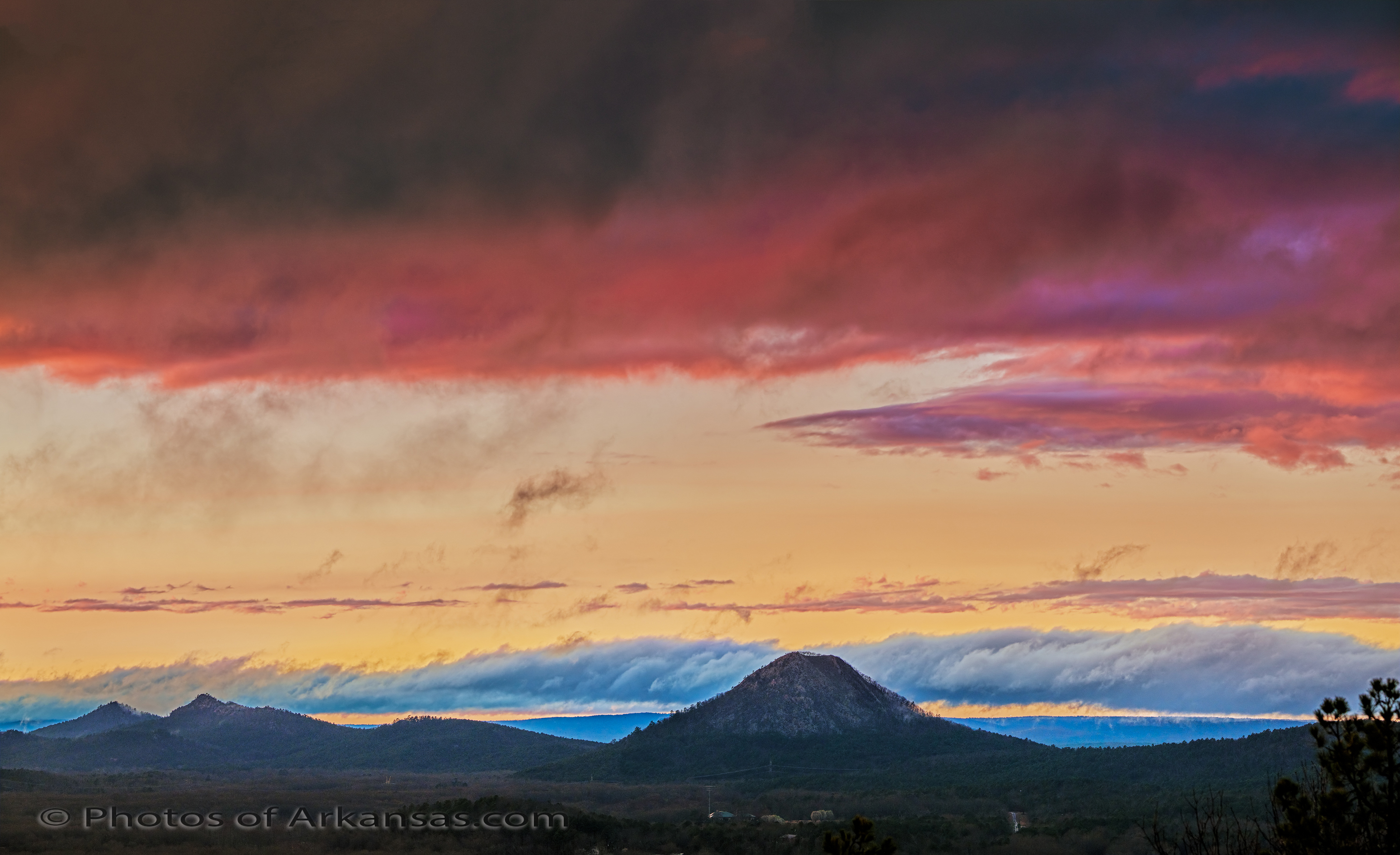
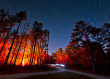
Sundown from Fort Roots looking towards Pinnacle Mountain

Sundown from Fort Roots--Click on photograph for a larger view

Taken with a Canon 5D MKII, 24-70 Lens at 35mm, F 14.  Created from 4 separate images taken at various exposures to capture the full dynamic range of the scene.   I love to get up to Fort Roots, as the view from around the summit is excellent.  You can get a great view of downtown Little Rock or if you walk around the track to towards the back side, you can catch some great views of western Little Rock.  Of course you will also be able to see Pinnacle Mountain which stands out like a volcano in the distance.  On this day, as the sun set, the entire sky turned a deep orange color which I tried to capture as best as I could without losing all the light around the sun.  I wanted to use the two pine trees in the foreground to frame the right side of the shot and hoped to capture some of the sky color in the river.  I ended up taking several exposures and then using a combination method developed by Tim Farr to combine all the images into one master images.

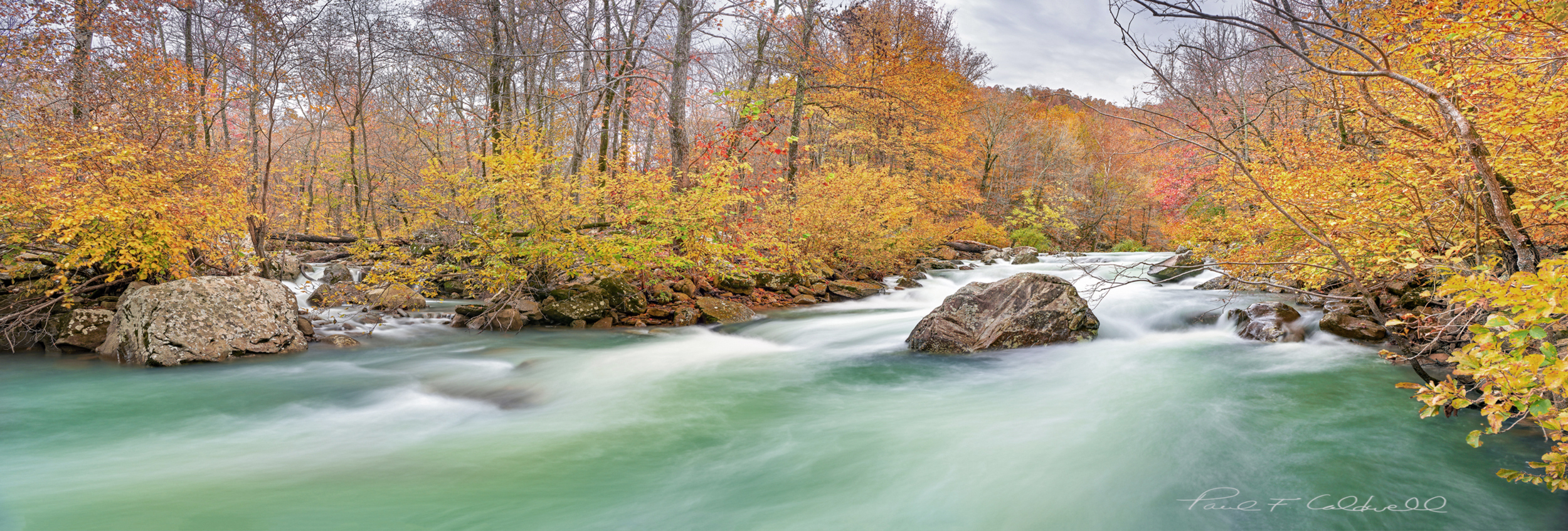
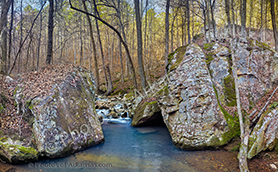
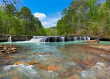
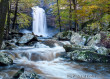
Cedar Creek below the Falls, Petit Jean Mountain

Cedar Creek below the Falls on Petit Jean Mt.--Click on photograph for a larger view

Taken with a Phase One P45, 35mm Lens, F16, ISO 50, with a CL-PL and ND4.   If  you plan on a trip up to Petit Jean this fall to catch some of the fall colors, plan to take a hike along Cedar Creek.  You can best get down to the creek from the Mather Lodge trail head, which starts behind Mather Lodge.  Along the trail which winds it’s way down the bluffs behind Mather Lodge, make sure you look for the small creek that run besides the trail as it offers some really great photographic opportunities.  This particular shot was taken while I climbed up in the rocks directly below Cedar Falls.  This area is one of the most photogenic in the whole area.  I used a CL-PL filter to cut the glare off the water and to help bring out the various colors on the trees.  The ND4 was added to give me a slow enough shutter speed to give the water the effect I wanted without blowing out the highlights.  This particular day was very windy so I had to time out the shot between the various gusts.